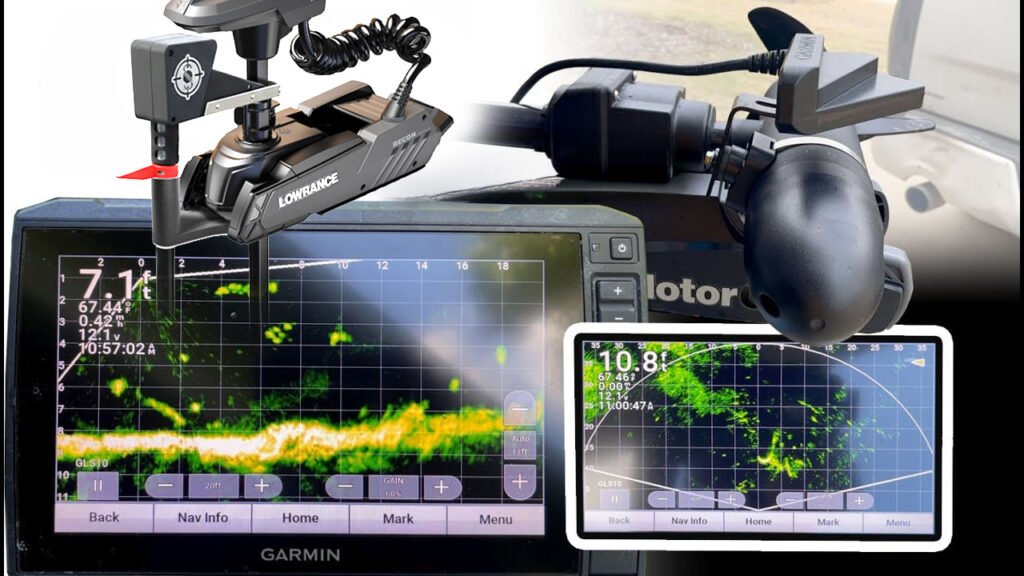
This is your Ultimate Guide to Forward Facing Sonar and this guide covers the fundamentals of setting up your FFS for maximum clarity and precision.
Forward Facing Sonar (FFS) like Garmin LiveScope, Lowrance ActiveTarget, and Humminbird MEGA Live has redefined how we find fish. However, the most expensive transducer in the world is useless if the image is shaky or the aim is inconsistent.
1. Why Stability is the #1 Performance Killer
The most common complaint with FFS isn’t the software—it’s “Screen Blur.” When your transducer mount flexes, even by a millimeter, the sonar beam (which is only about 20° wide) oscillates. At a distance of 60 feet, a tiny vibration at the mount translates into several feet of movement on the screen.
- The Culprit: Thin-walled plastic brackets or lightweight aluminum that “whips” when the trolling motor is under load.
- The Fix: A rigid, high-grade aluminum mount. Eliminating mechanical flex is the only way to get a “stilled” image that allows you to track a 1/16 oz jig at distance.
2. Independent vs. Trolling Motor Mounting
The “Trolling Motor vs. Pole Mount” debate is the first hurdle for any FFS user.
- Trolling Motor Shaft: Great for “search and destroy” fishing. Where you point the motor is where you see. The downside? If you use Spot-Lock, your sonar will spin wildly to maintain position, making it impossible to stay on a brush pile.
- Independent Pole Mount: This allows you to stay Spot-Locked on a breezy point while manually aiming your sonar at the target. It’s the preferred choice for crappie snipers and tournament anglers who need to “pick apart” a piece of cover.
3. The Quest for the 0° Mount: Why it Matters
Most factory transducer brackets come with a standard 8° tilt. While this was originally designed to help the sonar beam “see around” the trolling motor motor-pod, it creates a geometry problem for precision fishing.+1
- The Problem with 8°: Because the beam is canted, what you see on the screen isn’t perfectly aligned with where your pole or trolling motor is actually pointing. This “offset” makes it difficult to track your jig as it falls, especially in deep water.
- The 0° Advantage: Tournament pros and “snipers” are switching to 0° mounts because they align the sonar beam perfectly with the shaft.
- Precision Casting: When you see a fish on the screen at 0°, you know exactly where to cast. No more “leading” the fish or guessing the offset.
- Bait Tracking: It keeps your lure in the “sweet spot” of the beam from the moment it hits the surface until it reaches the bottom. Speaking of which, grab some goodies at Buzzed Baits.
- Cleaner Bottom Reads: Eliminating the tilt helps the sonar return a truer representation of the bottom contour, reducing the “slanted” look you sometimes see on flat terrain.
Pro Tip: If you’re switching to an independent pole mount like the RFL, a 0° bracket is almost mandatory. Since you don’t have a trolling motor in the way, that 8° factory “clearance” tilt only serves to distort your aim.
4. Cable Management: The Silent Transducer Killer
FFS cables are packed with sensitive shielding. Constant stowing and deploying of the trolling motor can pinch or “work-harden” the internal wires, leading to signal loss.
- Pro Tip: Always leave a “service loop” (extra slack) at the pivot point of your mount. Avoid zip-ties that are too tight; use specialized cable clips or electrical tape to allow for natural movement.